Is My ADA Lawsuit a Scam? Why the Same Plaintiffs Sue So Many Businesses

It's real, it's a volume business, and it can be defended

By Michael Samuel, ADA defense attorney in New York

Ceramics studio owner photographing a bowl for her online shop

You’ve been sued over your website, you looked up the plaintiff, and you found that the same person, or the same law firm, has sued dozens of other businesses. It’s natural to wonder whether this is a scam.

It isn’t, in the way that matters most. It is a real lawsuit, filed in a real court by a licensed lawyer, and it has a real deadline. But it is also a volume business, and that fact can work in your favor. My name is Michael Samuel. I’m an ADA defense attorney in New York, and I have defended about 100 ADA cases since 2019, most of them about websites. This article explains how serial ADA lawsuits work, why your business was picked, and how the volume itself can help your defense.

The most important fact first. Don’t ignore it because it looks like a form letter. In federal court you generally have 21 days from service to respond, or 60 days if you agreed to waive formal service. In New York State court it is 20 or 30 days, depending on how you were served. Missing the deadline can mean a default judgment against your business.

How many of these lawsuits are filed, and by whom

Federal courthouse on Pearl Street in Lower Manhattan on a sunny day

The numbers are public. In the 90 days to October 15, 2026, 263 lawsuits were filed in the federal courts for New York City, Long Island and the northern suburbs (the Southern and Eastern Districts of New York) under the court system’s ADA category, which covers website and building access cases. By our count of the court dockets, eight law firms filed 227 of them, and one firm filed 111, more than four in ten.

These counts don’t include New York State Supreme Court, where firms such as KSS Law file, or firms that mostly send demand letters, such as Equal Access Law Group and Apex Trial Law. We have also written about Mizrahi Kroub and Shaked Law Group.

The filings come in batches. On September 22, 2026, one firm filed six website lawsuits in Manhattan federal court in a single day. Over five days at the end of July and the start of August, another filed nine against fashion and luxury brands, all in the same plaintiff’s name. And in one case my firm defended this summer, the plaintiff had filed 54 near-identical lawsuits.

Why the same lawsuit gets filed again and again

Stack of identical printed pages in a copier's output tray

The federal law pays fees, not damages. Under the ADA, a private plaintiff can’t recover money damages, only an order to fix the site plus attorney’s fees. The money in New York cases comes from the New York State and New York City human rights laws, which are usually added to the same complaint.

The complaints are templates. Once a firm has a complaint that works against one website, the same document can be used against the next one with the names changed. In 2022, in Calcano v. Swarovski, the Second Circuit, the federal appeals court that covers New York, called one set of these complaints “Mad-Libs-style.” The same typos appeared in every one, and one plaintiff claimed he would return to a Kohl’s store that didn’t exist.

Settling is often cheaper than fighting. For many businesses, paying to make a case go away costs less than defending it, and plaintiffs’ firms know it. Published industry estimates put most small-business website settlements between $5,000 and $20,000, with New York cases often higher. Each settlement funds the next round of filings.

Who can sue is still contested. Some plaintiffs visit websites mainly to find barriers. Whether such a “tester” has suffered the kind of injury that allows a lawsuit is a question the courts have not settled. The Supreme Court agreed to decide it in 2023, in a case brought by a woman who had sued hundreds of hotels, then dismissed the case as moot after she dropped her lawsuits when one of her lawyers was sanctioned.

Why your business was picked

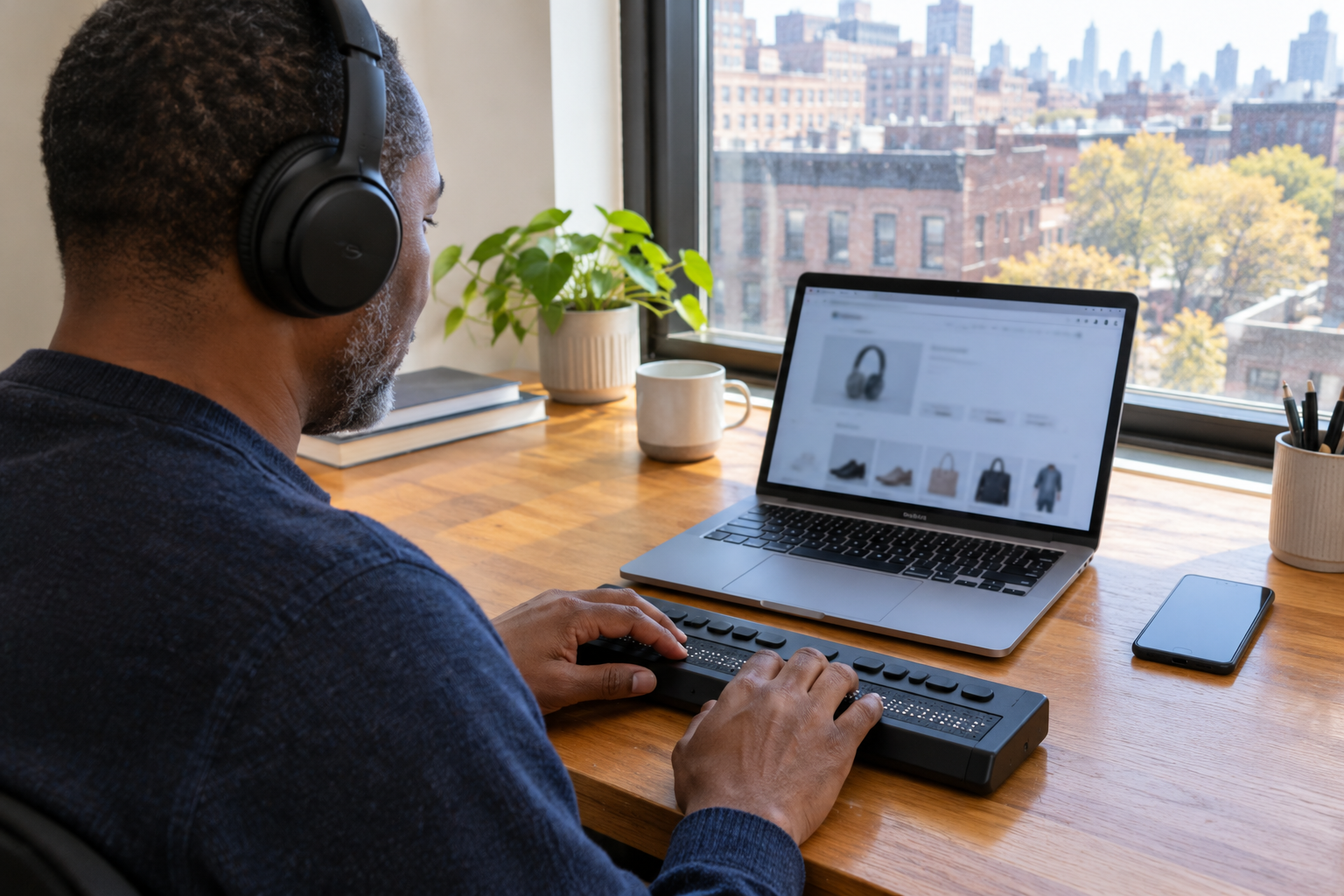
Blind man shopping online with a braille display and headphones

Usually not because of anything personal. Website suits in New York go after businesses that sell to New York customers online: shops and brands, restaurants, gyms, galleries and service companies. What the plaintiff’s firm looks for is a site with barriers a screen reader user runs into, such as images without text descriptions, buttons that can’t be reached with a keyboard, or checkout forms without labels.

The barriers are often real. Blind and low-vision people do use screen readers and braille displays to shop, and many sites don’t work with them. That is why fixing the site properly matters, both for the case and to avoid the next one. See whether to fix your website before or after you respond.

Being sued once doesn’t protect you from the next suit. By one industry count, about four in ten federal website accessibility lawsuits in 2024 named a business that had been sued before, and nearly 5,000 website accessibility suits were filed across the country in 2025.

Why the volume can help your defense

Magnifying glass over a row of nearly identical printed pages

Courts look harder at boilerplate. To sue, a plaintiff has to show a real injury and a real plan to come back to your website. Since the 2022 Calcano decision, New York federal courts have dismissed website cases where those claims were generic. The same appeals court held in 2022, in Harty v. West Point Realty, that a plaintiff who said a hotel website lacked accessibility information also had to show real consequences of not having it.

Filing history is evidence. In June 2026, in Sumlin v. Royal Batch, the Manhattan state court dismissed a website accessibility complaint we defended, finding the serial plaintiff’s standing allegations inherently incredible. In July 2026, in Alexandria v. Just Shades, the same court dismissed another complaint we defended in its entirety; that plaintiff had filed 54 near-identical lawsuits. Both decisions, with the index numbers, are on our results page. Prior results do not guarantee a similar outcome.

But volume alone isn’t a defense. Filing many lawsuits isn’t illegal, and each case is still decided on its own complaint and its own facts. The filing history helps when it is used to test what this plaintiff says about your website.

Where to start. Upload the complaint to our free complaint checker for a plain-English summary of who is suing, what they want and the date to plan around, or read how to read an ADA lawsuit complaint. If you received a letter rather than a lawsuit, start with what to do in the first 48 hours. For what a resolution usually costs, see how much it costs to settle an ADA website case.

How The Samuel Law Firm can help

Michael Samuel

Michael Samuel has defended about 100 ADA cases since 2019, most of them about websites, in New York state and federal courts. For website cases, the firm charges a flat fee that covers all work up to trial, including a motion to dismiss.

We track new ADA filings in the New York federal and state courts, so we usually know the plaintiff’s firm and filing history before you finish describing the complaint, and we use that history in the defense.

For the website itself, we work with Codexyo, an independent web accessibility team that fixes sites like yours. They are not lawyers, and you’re free to use anyone.

Frequently asked questions

Usually not. If the papers name a court and a case or index number, it is a real lawsuit filed by a licensed lawyer, with a real deadline, even if the same plaintiff has sued many other businesses. Ignoring it can lead to a default judgment against your business.
Because it is a volume business. The federal ADA pays the plaintiff’s attorney’s fees but no damages, the complaints are templates that can be reused, and many businesses settle because settling costs less than defending. Money claims under New York State and City law are usually added to the same complaint.

Not on the number of lawsuits alone. But a long filing history and boilerplate claims can support a challenge to the plaintiff’s standing, and New York courts have dismissed website cases on that basis, including two we defended in 2026. Prior results do not guarantee a similar outcome.

Look up the case number in the court’s public records: PACER for federal court, or NYSCEF for New York State Supreme Court. You can also call the court clerk, or upload the complaint to our free complaint checker for a plain-English summary of who is suing and the date to plan around.

No. A settlement ends that one claim. By one industry count, about four in ten federal website accessibility lawsuits in 2024 named a business that had been sued before, which is why fixing the site properly matters as much as resolving the case.

Talk it through

Free consultation, flat fee quoted before you commit

I am Michael Samuel. I have practiced law in New York since 1993 and I have handled roughly a hundred ADA accessibility matters, most of them website cases, for the business on the receiving end. If a letter or a lawsuit about your website has arrived, the first call costs nothing and you will get a straight answer about where you stand. I handle website accessibility defense on a flat fee, quoted before you commit, so you know the number up front.

Recent decisions in these cases, with the courts and index numbers, are on my results page. Prior results do not guarantee a similar outcome. If your letter came from a firm we have written about, see what to know about Equal Access Law Group letters and what to know about Apex Trial Law letters.

For a free consultation, call 212-563-9884, email michael@thesamuellawfirm.com, or use the contact form.

Attorney Advertising. This article is general information about New York law and is not legal advice about your situation. Reading it does not create an attorney client relationship.


The Samuel Law Firm

1441 Broadway, Suite 6085

New York, NY 10018

212-563-9884

Contact Us

Sued, owed wages, or injured? Talk to a New York litigator today.

The Samuel Law Firm is a litigation firm in Manhattan. Michael Samuel defends businesses in ADA lawsuits, website and premises, in wage and hour cases, and in contract and commercial disputes, and represents employees owed wages and people injured by negligence. He has practiced in New York since 1993 and appears in the Southern and Eastern Districts of New York and the New York state courts. Call 212-563-9884 for a free consultation; he answers directly