Restaurant Workers in New York: Are You Owed Overtime, Tips or the Extra Hour?

Long shifts, short pay: what New York law says about restaurant work

By Michael Samuel, attorney in New York

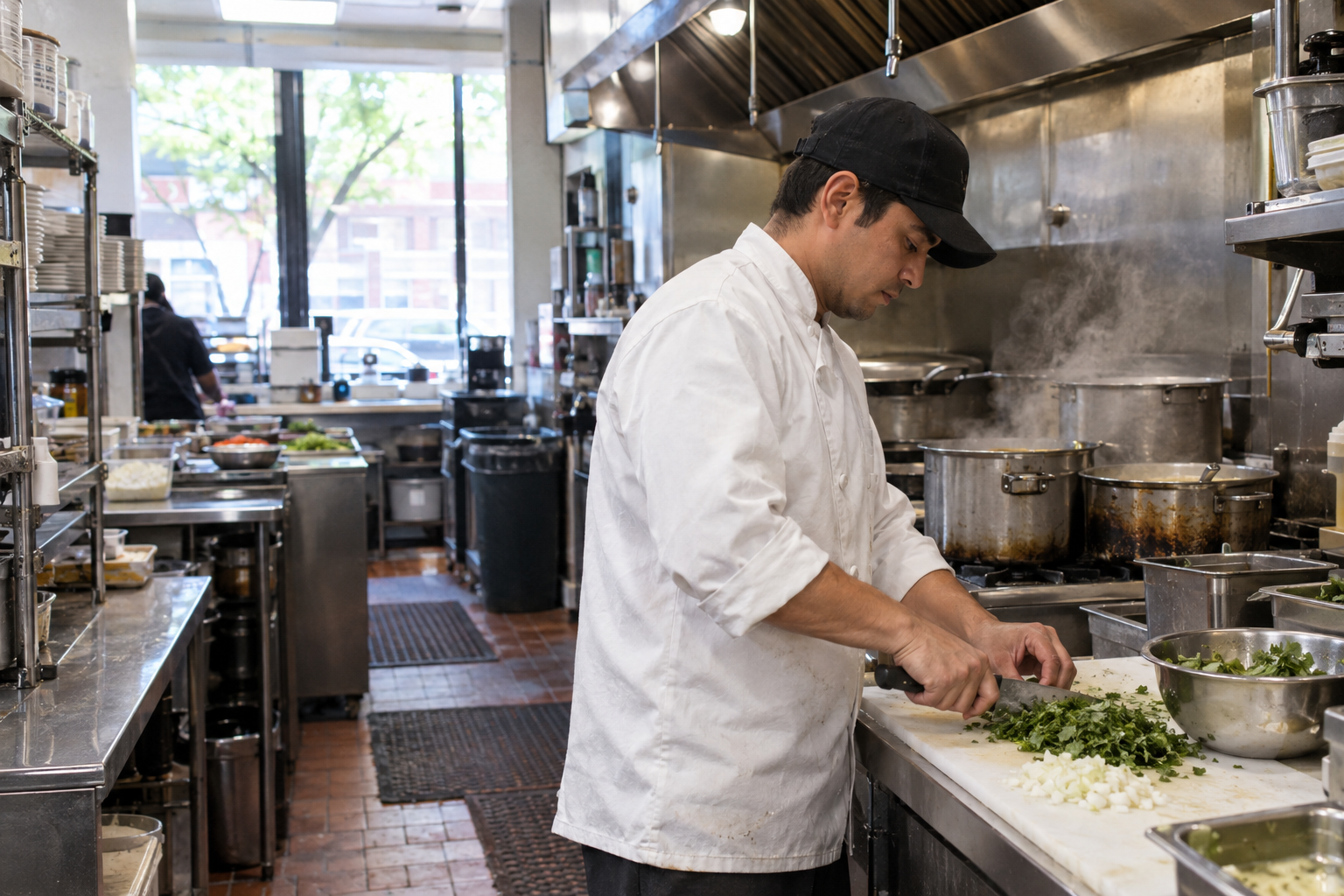
Line cook prepping vegetables in a bright Jackson Heights restaurant kitchen

So far in 2026, at least 112 wage lawsuits have been filed in New York’s federal courts against businesses with “restaurant,” “deli,” “café,” “pizza,” “bakery” or a similar word in their name. That count only catches the obvious names; restaurants owned through a numbered or generic company don’t show up in it. Behind each one is a worker who says the paycheck didn’t match the hours.

If you work in a New York restaurant, you may be in the same position and not know it. New York has a separate set of wage rules just for restaurants and hotels, and several of them give restaurant workers more than workers in other jobs get.

My name is Michael Samuel. I have practiced law in New York since 1993, and I handle wage and hour cases in the federal courts in Manhattan and Brooklyn and in the state courts. This article explains the rules that matter most: overtime, tips, the extra hour for long days, uniforms and short shifts. It also covers how far back you can claim and what to do now.

These rules apply to people employed by a restaurant, including kitchen staff and delivery workers on the restaurant’s own payroll. If you deliver through an app such as DoorDash or Uber Eats, different city rules apply; see our page on deactivated delivery workers.

Overtime: time and a half after 40 hours, however you're paid

Stacks of clean plates beside a commercial dishwasher in a restaurant kitchen

The rule is simple. If you work more than 40 hours in a week, you are owed time and a half for every extra hour. That is true whether you are paid by the hour, by the shift, by the day or a flat amount each week.

A flat weekly amount doesn’t cover your overtime. Many kitchen workers are paid something like $900 a week, cash or check, no matter how long they work. New York’s restaurant rules say that when an employer doesn’t pay an hourly rate, your hourly rate is found by dividing your weekly pay by 40 hours, or by your actual hours if you worked fewer. Every hour over 40 is then owed on top, at time and a half. On paper, someone paid $900 for a 60-hour week has an hourly rate of $22.50, and the 20 extra hours come to $675 a week in overtime. Over a year, that is more than $30,000.

If you get tips, the overtime math has a trap. The correct way is to take the full minimum wage, multiply by one and a half, and then subtract the tip credit. In New York City, Long Island and Westchester in 2026, that is $17.00 × 1.5 = $25.50, minus the $5.65 tip credit, so $19.85 an hour in cash for overtime. Some employers instead multiply the reduced cash wage of $11.35 by one and a half and pay about $17.03. The rules specifically say that method is wrong. The difference is almost $3 for every overtime hour.

A “manager” title doesn’t settle it. In New York City, Long Island and Westchester, a salaried manager can only be exempt from overtime if the salary is at least $1,275 a week in 2026 ($1,199.10 in the rest of the state) and the job really is managing. A kitchen manager who mostly cooks, or a floor manager who mostly serves, may still be owed overtime. More on that on our employee misclassification page.

Tips: when your boss can pay less than minimum wage, and when it can't

Open black check presenter and a pen on a sunlit marble bar top

Restaurants are allowed to pay tipped servers, bussers, runners and bartenders a lower cash wage and count part of their tips toward the minimum wage. That’s called a tip credit. For 2026, the cash wage for these workers is $11.35 an hour in New York City, Long Island and Westchester, with a $5.65 tip credit, and $10.70 an hour in the rest of the state, with a $5.30 credit.

But the tip credit comes with conditions, and when the restaurant doesn’t meet them, it owes the full minimum wage for those hours:

  • You must be told in writing. Before you start, the restaurant has to give you written notice of your pay rate, your overtime rate and the tip credit it takes, in English and in your main language if the state publishes a form in it. You sign to confirm you got it. If it can’t prove it gave you that notice, it can’t take the credit.
  • Not too much side work. On any day you spend more than two hours, or more than 20 percent of your shift, on work that doesn’t earn tips, such as prep, cleaning or stocking, the restaurant can’t take the tip credit for that day.
  • Your tips must make up the difference. If your tips plus your cash wage don’t reach the minimum wage, the restaurant has to pay the rest.

Your tips are yours. New York law bars an employer, or anyone acting for it, from taking any part of a worker’s tips. Tips can be shared with other workers who help serve, like bussers and runners, but in 2013 New York’s highest court ruled that anyone with meaningful authority over other workers, such as the power to hire, fire, discipline or set schedules, can’t share in the tip pool. And a “service charge” added to the bill is presumed to be a tip that belongs to the workers who served, unless the restaurant can show customers were clearly told it wasn’t.

The extra hour, the uniform and the shift that got cut short

Row of freshly laundered chef jackets and aprons hanging on a rack

The extra hour for long days. If more than ten hours pass between the start and the end of your workday, counting breaks and time off in the middle, you are owed one extra hour of pay at the minimum wage for that day. Outside restaurants and hotels, New York courts generally limit this to workers paid near the minimum wage. In restaurants, the rule itself says it applies to every worker, whatever they earn. A split shift that starts at 11 and ends at 10 at night crosses that line every day it happens.

Sent home early. If you show up for a shift because you were scheduled or asked to, and the restaurant sends you home or has no work for you, you are still owed pay. For one shift, that is generally at least three hours, or your usual shift if it is shorter, and the hours you didn’t work are paid at the full minimum wage, with no tip credit.

Your uniform. If the restaurant requires a uniform that needs dry cleaning, ironing or other special care and doesn’t clean it for you, it owes you a weekly uniform payment on top of your wages. The exception is a uniform that is genuinely wash-and-wear and can go in the wash with your own clothes, provided in enough sets for the days you work.

None of these are large amounts on any single day. Over months and years, they add up, and they are the items employers most often leave off the paycheck.

How far back you can go, and what to do now

Restaurant worker on a break writing notes on a phone in a sunny alley

Six years back. Under New York law, you can generally recover unpaid wages for the last six years. Federal law reaches back two years, or three if the violation was willful. If the employer can’t show it acted in good faith, New York adds an equal amount as liquidated damages, so the unpaid wages can double, plus interest and attorney’s fees. That is why these cases are handled on contingency and cost you nothing up front.

Immigration status doesn’t change your right to be paid. The New York Attorney General’s office states plainly that workers in New York have rights, including minimum wage and overtime, “regardless of their immigration status.” Since 2019, New York law also treats threatening to call immigration authorities, or to report a worker’s status, as illegal retaliation for a wage complaint.

What to do now:

  1. Write down your hours, starting today. Date, start time, end time and breaks. A note on your phone is enough. When an employer’s records are missing or wrong, a worker’s own consistent account carries real weight.
  2. Photograph the schedule. Weekly schedules, tip-out sheets, group chats where a manager tells everyone when to come in. Save every pay stub and any paper you signed at hire, especially the tip credit notice.
  3. Write down how you’re paid. Hourly or a flat amount, cash or check, and how tips are split and who takes part.
  4. Don’t sign anything new without reading it. A release, a new “agreement” or a small check offered after you ask about your pay can give up far more than it pays.
  5. Don’t wait. Every month that passes takes a month off the oldest end of your claim.

How The Samuel Law Firm can help

Michael Samuel

Michael Samuel has practiced law in New York since 1993 and handles wage and hour cases in the Southern and Eastern Districts of New York and in the state courts. He represents workers who are owed wages, and he also defends employers in these cases, so he knows how restaurants argue about hours, tips and records.

In one case, he represented kitchen workers employed by a New York restaurant for four to six years who were paid below the minimum wage and worked long hours without overtime. Their claims under federal and New York law settled before trial for a confidential amount in excess of $250,000. More outcomes are on the results page. Prior results do not guarantee a similar outcome.

Wage cases are handled on contingency, so a first conversation costs nothing. Hablamos español. Para leer en español, vea ¿Le pagan lo mismo por todas las horas?

Frequently asked questions

Yes. Restaurant workers in New York are owed time and a half for every hour over 40 in a week, whether they are paid hourly, by the shift or a flat weekly amount. When a restaurant pays no hourly rate, New York’s rules treat the weekly pay as covering 40 hours at most, so the hours over 40 are owed on top. A manager title alone doesn’t remove the right to overtime.

Only under conditions. In 2026 the cash wage for tipped food service workers is $11.35 an hour in New York City, Long Island and Westchester and $10.70 in the rest of the state. The restaurant must give you written notice of the tip credit before you start, your tips must bring you up to the full minimum wage, and it can’t take the credit on days you spend more than two hours or 20 percent of your shift on untipped work.

Not if they have meaningful authority over other workers. New York law bars employers and their agents from taking any part of employees’ tips, and in 2013 New York’s highest court held that workers with meaningful or significant authority, such as hiring, firing, discipline or setting schedules, can’t share in a tip pool. A service charge added to the bill is presumed to be a tip that belongs to the workers who served.

Very possibly. Under New York’s restaurant rules, if the employer doesn’t pay an hourly rate, your weekly pay is divided by 40 hours, or by your actual hours if fewer, to find your hourly rate. Every hour over 40 is then owed at time and a half on top of the weekly amount. Someone paid $900 for 60 hours a week can be owed about $675 a week in overtime.

If more than ten hours pass between the start and end of your workday, including breaks, you are owed one extra hour of pay at the minimum wage for that day. In restaurants and all-year hotels, New York’s rules apply it to every worker, regardless of their regular rate of pay. Split shifts often trigger it.

Yes. The New York Attorney General’s office states that workers in New York are entitled to minimum wage and overtime regardless of their immigration status. New York law also makes it illegal retaliation for an employer to threaten to call immigration authorities or report a worker’s status because of a wage complaint.

Talk it through

Free, confidential call. I answer directly.

I am Michael Samuel. I have practiced law in New York since 1993 and I handle wage and hour cases in the Southern and Eastern Districts of New York and in the state courts. I represent employees who are owed wages, and I also defend employers in these cases, which means I know exactly how the other side argues about hours, tips and the records it kept.

If you work in a New York restaurant and your pay doesn’t add up, it costs nothing to find out where you stand. The call is free and confidential, and I answer directly.

Call 212-563-9884, email michael@thesamuellawfirm.com, or use the contact form. Hablamos español: 929-696-1725.

For more on overtime and unpaid wages in New York, see our unpaid wages and overtime page. Delivery drivers on a route should also read FedEx and Amazon delivery drivers in New York.

Attorney Advertising. This article is general information about New York law and is not legal advice about your situation. Reading it does not create an attorney client relationship. Prior results do not guarantee a similar outcome.


The Samuel Law Firm

1441 Broadway, Suite 6085

New York, NY 10018

212-563-9884

Contact Us

Sued, owed wages, or injured? Talk to a New York litigator today.

The Samuel Law Firm is a litigation firm in Manhattan. Michael Samuel defends businesses in ADA lawsuits, website and premises, in wage and hour cases, and in contract and commercial disputes, and represents employees owed wages and people injured by negligence. He has practiced in New York since 1993 and appears in the Southern and Eastern Districts of New York and the New York state courts. Call 212-563-9884 for a free consultation; he answers directly