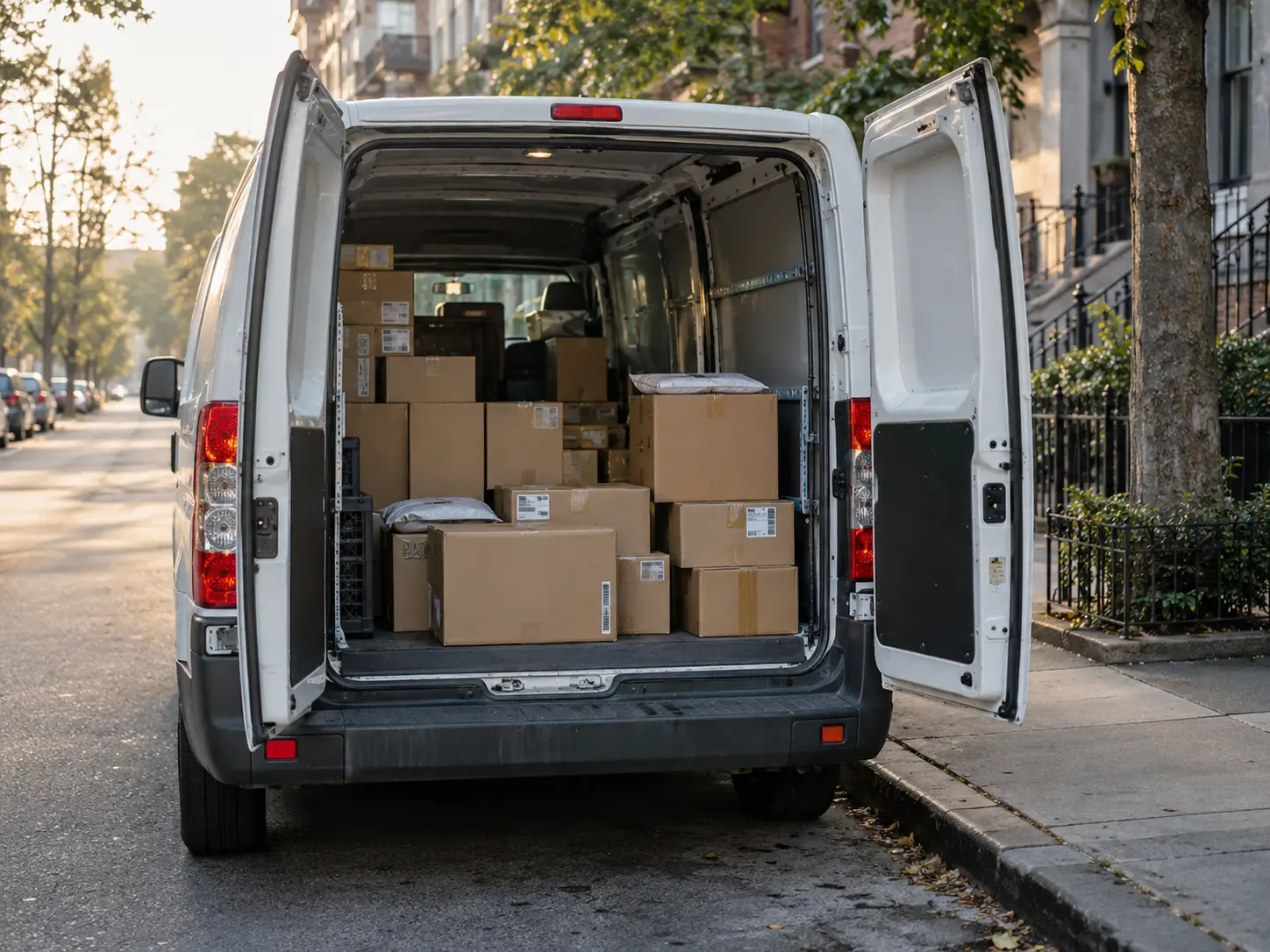
In the first two weeks of September, more than 120 lawsuits were filed in New York federal courts by delivery drivers who say they were not paid properly for their hours. They were all filed by one plaintiffs’ firm, and they all name FedEx.
If you drive a route in New York, that news raises a fair question: does any of this apply to me?
It might, and not only if you deliver for FedEx. The problem those cases describe is the ordinary arrangement for route delivery in this state. You are hired by a small local company. You wear the big company’s uniform, drive its van, scan its packages and run the route it sets. You work ten, eleven, twelve hours a day. Your check does not show time and a half.
Here is what New York law actually says about that.
Who is your employer, and why it may be more than one company
FedEx and Amazon do not usually hire route drivers directly. They contract with small companies that run a handful of routes each. FedEx calls them independent service providers. Amazon calls them delivery service partners. You are on that small company’s payroll, and that company is the one that decides your pay.
That matters in two ways.
First, your unpaid wage claim is against whoever employed you, and that is usually the contractor, not the brand on the van. Many drivers assume they have no case because they cannot sue a company the size of FedEx. That gets it backwards. The company that shorted you is the one that owes you.
Second, the bigger company can sometimes be on the hook as well. When one company sets the route, the schedule, the scanner, the delivery windows and the standards you are measured against, the law can treat it as your employer too. That is the argument in the wave of cases filed this month. It is fact specific, it is fought hard, and it is not something to assume. But it is a real question worth asking about your own job.
The overtime rule, and the trap most drivers are told about
The basic New York rule is simple. Over forty hours in a week, you are owed time and a half.
Drivers are often told that rule does not apply to them, and there is a real federal provision behind that. Under the Fair Labor Standards Act, a driver whose work affects the safety of a vehicle over 10,000 pounds carrying goods across state lines can be exempt from federal overtime. It is called the motor carrier exemption, and employers of delivery drivers reach for it constantly.
Two things are usually left out when a driver is told this.
The exemption does not cover smaller vehicles. If the vehicle you drive is 10,000 pounds or less, the exemption does not apply and federal overtime does. Many delivery vans sit close to that line, and plenty fall under it. If you drive a mix of vehicles, the weeks you spend in the smaller one count.
In New York, the exemption does not end the claim. This is the part almost nobody is told. In 2020 the Second Circuit, the federal appeals court that covers New York, held that a driver who is exempt from overtime under the federal motor carrier rule is still owed overtime under New York law, at one and a half times the New York minimum wage, for every hour over forty. The case was brought by armored car drivers whose employer insisted they were exempt. They were exempt federally. They were still owed money.
So in New York a route driver is not left with nothing. The only question is the rate.
The extra hour nobody claims
New York has a rule called spread of hours. If the time between the start and the end of your workday is more than ten hours, you are owed an extra hour of pay at the minimum wage for that day, on top of everything else.
Routes run long. A driver who starts loading at 7 and finishes at 6 has crossed that line, even with a break in the middle. For 2026 the minimum wage is $17.00 an hour in New York City, Long Island and Westchester, and $16.00 in the rest of the state. Do that five days a week for a year and the number gets serious on its own.
In my experience this is the single most commonly missed item in driver pay, because almost nobody knows it exists.
How far back it goes, and what it is worth
New York’s wage law reaches back six years. Federal law reaches back two, or three if the violation was willful. Most drivers use the six.
If a court finds the wages were not paid in good faith, New York adds liquidated damages equal to the amount owed. In plain terms, the unpaid wages can double. Interest and attorney’s fees are on top of that, which is why these cases are handled on contingency and cost you nothing up front.
Two more things worth saying plainly.
Immigration status does not matter. New York’s wage protections cover the work you did, not your papers. Employers know that workers are afraid to ask, and some of them count on it.
Being called a contractor does not settle it. Whether you are an employee is decided by how the job actually works, not by the label on your paperwork or what you signed at hire. If someone else sets your hours, your route and your standards, and the work is the core of their business, the label is not the end of the analysis.
Where this does not go
App work is a different animal. If you deliver for DoorDash, Uber Eats, Grubhub or a similar app, picking up jobs when you choose, that is not the same situation as a route driver and the law treats it differently. Some of those arrangements are being challenged. Most are harder, slower and governed by arbitration clauses you agreed to in the app. I would rather tell you that at the start than after.
This article is about route delivery: a set schedule, an assigned route, a company van, a supervisor.
What to do now
Start writing down your own hours. Today, not later. The date, the time you clocked in, the time you finished, and any unpaid time before or after the shift. A note on your phone is enough. In wage cases, the employer is the one required to keep accurate records, and when those records are missing or wrong, a worker’s own consistent account carries real weight.
Keep what you already have. Pay stubs, the hire paperwork, scanner or route reports, group chats where a manager tells everyone what time to be there. Photograph anything you can only see at work.
Do not sign anything new without reading it. If a release, a settlement or a revised contractor agreement appears after you start asking about your pay, that timing is not a coincidence.
Ask before the six years starts running out. Every month that passes drops a month off the back end of the claim.
Talk it through
I am Michael Samuel. I have practiced law in New York since 1993 and I handle wage and hour cases in the Southern and Eastern Districts of New York and in the state courts. I represent employees who are owed wages, and I also defend employers in these cases, which means I know exactly how the other side argues the motor carrier exemption and the contractor label.
If you drive a route in New York and your check does not show time and a half, it costs nothing to find out where you stand. The call is free and confidential, and I answer directly.
The Samuel Law Firm, 1441 Broadway, Suite 6085, New York, NY 10018. Call 212-563-9884. Hablamos español: 929-696-1725.
For more on how the motor carrier exemption works in New York, see Are All New York Truck Drivers and Mechanics Eligible for Overtime Pay?
Attorney Advertising. This article is general information about New York law and is not legal advice about your situation. Reading it does not create an attorney client relationship.